
Bread Flour Cups to Grams
Bread flour is 120 g per US cup in King Arthur Baking's chart, which this calculator uses. Allrecipes publishes 136 g per cup, while Bob's Red Mill lists 144 g for its named Artisan Bread Flour. Check your recipe's original source before applying this fixed 120 g result.
Reference measurement
120 grams per US cup
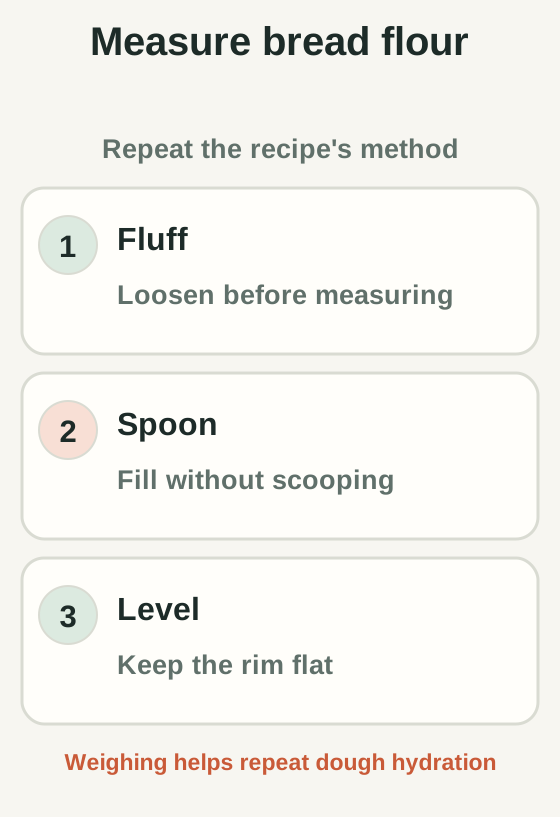
Fluff, spoon into a dry US cup, and level without compacting.
King Arthur Baking lists 1 cup bread flour as 120 g. Source note
This value follows King Arthur's bread flour standard; brands can mill differently.
Choose the bread-flour cup standard your recipe uses
These published US-cup references describe different recipe or product assumptions. Use the recipe author's stated grams first, or match the actual named product and measuring method.
Bread flour: named source weights
| Reference | 1 US cup | 2½ US cups |
|---|---|---|
| King Arthur Baking — Bread Flour | 120 g | 300 g |
| Allrecipes — bread flour chart | 136 g | 340 g |
| Bob's Red Mill — Artisan Bread Flour | 144 g | 360 g |
The live calculator and the original eight-row table do not switch from King Arthur's 120 g/cup when you consult another source. Bob's 144 g figure belongs specifically to Artisan Bread Flour; none of these values is a universal mass for every filled cup.
Convert the bread-flour amount using its actual recipe convention
If the recipe already supplies a flour weight in grams, weigh that amount; do not recompute from an unrelated cup chart. King Arthur Baking's ingredient chart gives Bread Flour at 120 g per US cup, Allrecipes' bread-flour chart uses 136 g, and Bob's Red Mill's flour chart assigns 144 g specifically to its Artisan Bread Flour. Each is a source-bound convention rather than a correction to the others.
For a cups-only formula specifically using Bob's Artisan Bread Flour, 2½ US cups × 144 g/cup = 360 g. The same cups yield 340 g under Allrecipes or 300 g under King Arthur, a 60 g difference between Bob's and King Arthur. To reverse Bob's amount, 360 g ÷ 144 g/cup = 2½ US cups. Dividing that weight by this page's default 120 g/cup would instead suggest 3 cups; the calculator stays on the King Arthur standard. Use the SAME source in both directions, ideally weighing the selected gram amount.
Keep the recipe's actual dough formula when measuring or substituting
If a bread recipe specifies 300 g of flour, put a bowl on a digital scale, press tare, and add 300 g of the flour it calls for. King Arthur lists 120 g/cup for both its bread flour and all-purpose flour, but matching volume-to-weight numbers do not establish identical protein or dough behavior. Changing flour type or brand can change dough handling, so no cup chart tells you exactly how much water, kneading or rise time to alter.
When a cups-only dough seems unexpectedly stiff, check whether the original recipe calls for spooning and leveling or another fill method. Directly scooping flour from a bag may pack a cup, but dough texture cannot reveal an exact excess flour weight after mixing. Our How to Measure Flour guide covers repeatable cup technique. Follow the original recipe's troubleshooting instructions rather than automatically adding a guessed amount of water based on another source's chart.
Common Bread Flour measurements
| US cups | Grams |
|---|---|
| 0.25 US cups | 30 grams |
| 0.333 US cups | 40 grams |
| 0.5 US cups | 60 grams |
| 0.667 US cups | 80 grams |
| 0.75 US cups | 90 grams |
| 1 US cup | 120 grams |
| 1.5 US cups | 180 grams |
| 2 US cups | 240 grams |