
How to Measure Flour
If the recipe gives grams, weigh that amount. For a cup-only recipe using a light spoon-and-level method, loosen flour, spoon it gently into a dry measuring cup, then level the rim without packing. Follow the author's own method if it differs; flour has no universal grams per cup.
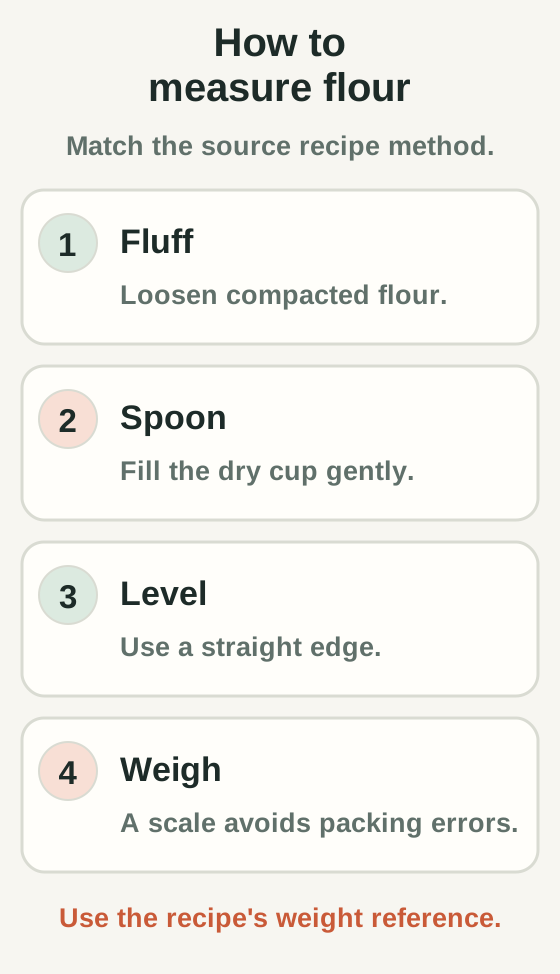
Identify which flour measurement the recipe expects
If the recipe specifies 240 g of all-purpose flour, weigh 240 g; a separate website's cup estimate should not overrule that quantity. If only cups are given, look for the author's measuring instructions. A recipe developed using scoop-and-sweep can legitimately assign a different mass to its level cup than a spoon-and-level recipe. The goal is to reproduce the method that the recipe was tested with, not to impose a single global grams-per-cup number. If the author gives no cup method, gently spooning and leveling is a practical starting point, not proof of a particular gram weight.
King Arthur Baking uses about 120 g per US cup for its all-purpose flour under its published measuring method. Its guide shows how a compacted cup can hold substantially more. That figure is a named baking reference, not an assertion that our team weighed flour or that every brand, grind and measuring method shares one density. Sally's Baking Addiction documents 125 g per cup of its all-purpose flour for its recipes, illustrating why authors' house references matter.
All-purpose flour cup weights depend on the recipe publisher
| Publisher and tested cup method | 1 US cup reference | 2 US cups by that reference |
|---|---|---|
| King Arthur Baking (fluff, sprinkle, level) | 120 g | 240 g |
| Sally's Baking Addiction (spoon, level) | 125 g | 250 g |
| America's Test Kitchen (dip, sweep) | about 142 g | about 284 g |
If the recipe follows King Arthur's light cup method
- Loosen compact flour in its container before filling the cup.
- Spoon or sprinkle flour gently into a dry measuring cup without tapping it down.
- Slightly overfill the cup and scrape the top level with a straight edge.
- Follow a different method or exact gram value if the original recipe specifies one.
Weigh the flour or follow the matching cup method
Set an empty bowl on a kitchen scale, select grams and press tare to return the displayed value to zero. Add flour gradually until it reaches the recipe's target. If you switch bowls or add ingredients between steps, tare only when doing so is consistent with the quantities the recipe needs. For a formula you plan to repeat, record the actual grams rather than converting back to a vague cup estimate.
A 1½-cup King Arthur all-purpose-flour target is approximately 1.5 × 120 = 180 g under that publisher's convention. For a concrete comparison, America's Test Kitchen says it uses a dip-and-sweep method—dip a dry measuring cup into flour and level it with a straight edge—and a 5-ounce (about 142 g) all-purpose-flour cup standard for its own recipes. That is different from King Arthur's lighter fluff, sprinkle and level method. For two cups, these published references imply 240 g for King Arthur, 250 g for Sally's Baking Addiction, or about 284 g for America's Test Kitchen. If you are following a cup-only America's Test Kitchen recipe, match its dip-and-sweep rather than silently using King Arthur's lighter cup; likewise, do not change a King Arthur or Sally recipe to dipping to chase 142 g. Author-provided weights take priority, and none of these house standards is a universal flour conversion. To see the reference used by the on-site calculator, consult the all-purpose flour cups-to-grams reference.
Sifted flour is a procedural instruction. '1 cup sifted flour' commonly means sift then measure; '1 cup flour, sifted' commonly means measure then sift, but punctuation alone cannot prove a particular author's intent. Look for the recipe's method notes and whether weight is given. Different flour types or sift states need their own references.
Investigate an unexpectedly stiff dough
If a dough is unexpectedly stiff, first check whether flour was scooped/packed, the recipe required another flour type, the ingredient list specified a particular cup weight, or an extra spoonful was added during kneading. Too much flour relative to water is a plausible cause, but eggs, moisture and technique also matter. Do not assume a fixed tablespoon of water always repairs it.
If you measured from an unfamiliar cup-only recipe, compare the flour technique on the author's site before altering its hydration. Once you understand the method and desired dough feel, make any correction incrementally and record what changed. This is a troubleshooting decision framework, not a claim that we performed a kitchen experiment.
120 g/cup and method-specific variability: King Arthur Baking flour-measuring method.