
All-Purpose Flour Cups to Grams
For all-purpose flour, this calculator uses King Arthur Baking's 120 g per US cup reference. If your recipe or flour brand specifies another weight, follow that original reference instead.
Reference measurement
120 grams per US cup
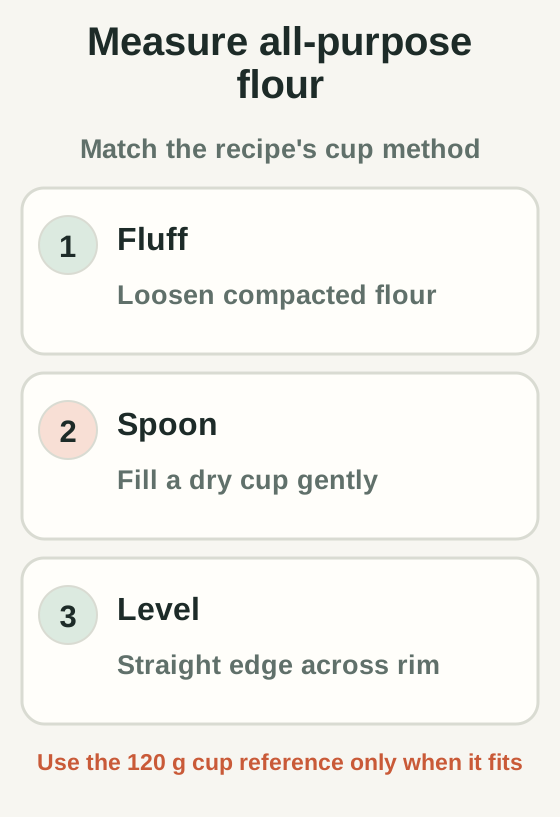
Fluff, spoon into a dry US cup, and level without compacting.
King Arthur Baking lists 1 cup all-purpose flour as 120 g. Source note
Scooping directly from the bag can pack in substantially more flour.
Choose the cup weight used by your recipe
If your recipe supplies grams, weigh those grams. If it supplies cups only, check its author's measurement instructions before choosing a conversion. This page's calculator and eight-row chart always use King Arthur's 120 g/cup reference.
Source-specific all-purpose flour cup weights
| Reference / condition | 1 US cup | 2 US cups |
|---|---|---|
| King Arthur Baking — all-purpose flour | 120 g | 240 g |
| America's Test Kitchen — its recipe standard | about 142 g | about 284 g |
| Bob's Red Mill — Organic Unbleached White AP | 136 g | 272 g |
America's Test Kitchen specifies 5 ounces per cup (about 142 g); its row is rounded. Bob's Red Mill's row is for the named flour product, not every flour or every recipe using that brand. These are recipe/product conventions, not an adjustable setting in the calculator above.
Use the reference that belongs to your recipe
A cup is a volume, not a single all-purpose-flour weight. King Arthur Baking's ingredient chart sets this calculator's lightly measured all-purpose flour at 120 g per US cup. America's Test Kitchen's own flour standard is 5 oz (about 142 g) per cup in its recipes. Bob's Red Mill's flour chart gives 136 g per cup for its named Organic Unbleached White All-Purpose Flour. Use your recipe author's gram target first; an author's standard takes priority over a flour-bag or unrelated conversion chart.
For a different amount, multiply the number of US cups by the grams-per-cup number from your chosen source. Example: 1½ cups × 136 g = 204 g for the named Bob's flour reference; the same 1½ cups is 180 g with this King Arthur-based calculator. For the reverse conversion, divide grams by the chosen grams-per-cup value: 204 g ÷ 136 g/cup = 1½ US cups by Bob's reference, but 204 g ÷ 120 g/cup = 1.7 US cups by King Arthur's. Weighing 204 g is more reliable than approximating an awkward cup fraction. The calculator above does not switch when you consult another row.
If the dough is stiffer than expected
Before adjusting a recipe's liquid, check how the flour went into the cup. Scooping directly from a bag can pack in far more flour than lightly filling and leveling. King Arthur's flour-measuring explanation notes that a compacted cup can hold up to 160 g compared with its roughly 120 g reference; two such heavily packed cups could therefore approach 320 g rather than the intended 240 g. That is an illustrative upper scenario, not a measurement of your own cup or a reason to automatically add water.
If the ingredients are already mixed, texture alone cannot reveal exactly how many extra grams entered the bowl. Check the recipe's flour type, printed gram amount and other liquid quantities before making a correction. For the next batch, weigh the original recipe target or follow its specified volume method. The How to Measure Flour guide explains dry-cup filling, weighing and why sifted-flour wording can change the result.
Common All-Purpose Flour measurements
| US cups | Grams |
|---|---|
| 0.25 US cups | 30 grams |
| 0.333 US cups | 40 grams |
| 0.5 US cups | 60 grams |
| 0.667 US cups | 80 grams |
| 0.75 US cups | 90 grams |
| 1 US cup | 120 grams |
| 1.5 US cups | 180 grams |
| 2 US cups | 240 grams |