
Whole-Wheat Flour Cups to Grams
This calculator uses 113 g per US cup for King Arthur Baking's Premium 100% Whole Wheat Flour. That number does not automatically apply to whole-wheat pastry flour or a recipe using a different cup weight. Check the flour name and the recipe's own grams before converting.
First, match the flour named in your recipe
Use these as different instructions, not three interchangeable estimates. The calculator on this page stays fixed at 113 g per US cup.
- The recipe gives grams: Weigh the amount printed in the recipe. No cup-to-gram estimate is needed.
- King Arthur Premium 100% Whole Wheat Flour: Use the 113 g-per-US-cup chart and the calculator above if this is the method your recipe calls for.
- Whole-wheat pastry or graham flour: King Arthur lists this distinct flour at 96 g per US cup. The 113 g calculator does not calculate this variety.
- A recipe or chart using another publisher's reference: Milk Street publishes 140 g per US cup for whole wheat in its separate flour-weight survey. Use that chart's amount only when its convention applies to your recipe.
Reference measurement
113 grams per US cup
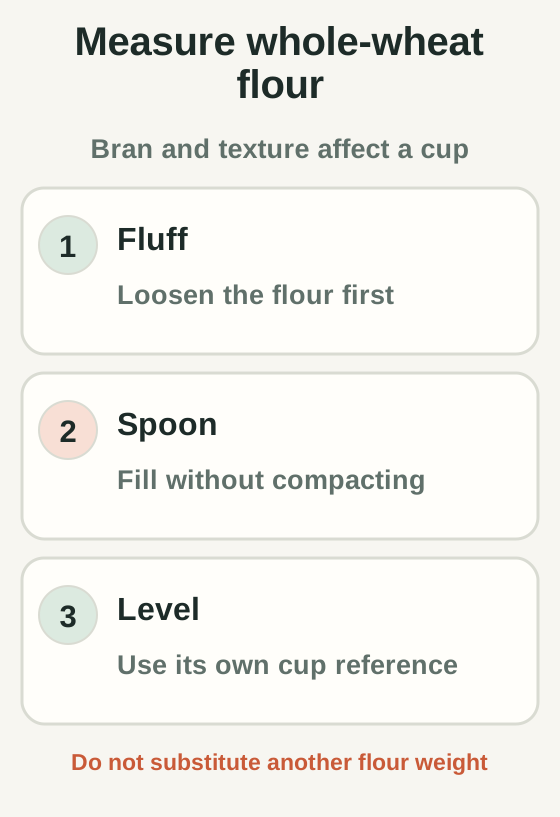
Fluff, spoon into a dry US cup, and level without compacting.
King Arthur Baking lists 1 cup premium 100% whole wheat flour as 113 g. Source note
Whole-wheat pastry flour is lighter and has a separate cup weight.
A flour's name changes which number belongs in the cup
On King Arthur Baking's ingredient weight chart, Premium 100% Whole Wheat Flour weighs 113 g per US cup, but Whole Wheat Pastry Flour / Graham Flour is listed at 96 g. For two cups, that is 226 g versus 192 g. The lighter figure is not a measuring shortcut for regular whole wheat: the whole-grains guide describes pastry flour as a softer-wheat product suited to tender baking rather than a direct stand-in for yeast bread.
Milk Street's published flour-weight survey gives 140 g per cup for its whole-wheat reference after comparing published weights and its own checks. It even names King Arthur as a suggested brand, but its 140 g reference and King Arthur's separate 113 g chart do not become the same measuring instruction. At two cups, following the 140 g table gives 280 g rather than 226 g. The difference tells you to check which source the recipe actually follows, not to average the numbers.
When cups and grams disagree, finish with the recipe's method
If your recipe already calls for 280 g of whole-wheat flour, weigh 280 g. If it instead says two US cups and explicitly uses a 140 g-per-cup reference, multiply 2 × 140 = 280 g. For the reverse conversion, 280 g ÷ 140 g/cup = 2 US cups. Enter 280 g in this page's fixed 113 g calculator and you would get about 2.48 US cups; that result belongs to a different source standard, not the same recipe.
If a cups-only recipe simply says "whole-wheat flour" without identifying its method, look for the original publisher's conversion chart or instructions. King Arthur's 113 g value is one named reference, not a guaranteed weight for every bag or scooping technique. Spoon lightly and level when following the King Arthur method; packing changes the result. A cup-to-gram calculation also cannot predict a dough's hydration or prove that pastry flour will behave like bread flour—use the original baking instructions for substitutions.
Common Whole-Wheat Flour measurements
| US cups | Grams |
|---|---|
| 0.25 US cups | 28.25 grams |
| 0.333 US cups | 37.67 grams |
| 0.5 US cups | 56.5 grams |
| 0.667 US cups | 75.33 grams |
| 0.75 US cups | 84.75 grams |
| 1 US cup | 113 grams |
| 1.5 US cups | 169.5 grams |
| 2 US cups | 226 grams |