
Dry vs Liquid Measuring Cups
For pourable liquids like water or milk, use a marked liquid cup on a level counter. For flour or thick yogurt, use a rim-level dry cup and the recipe's filling method. Both represent the same nominal US cup volume.
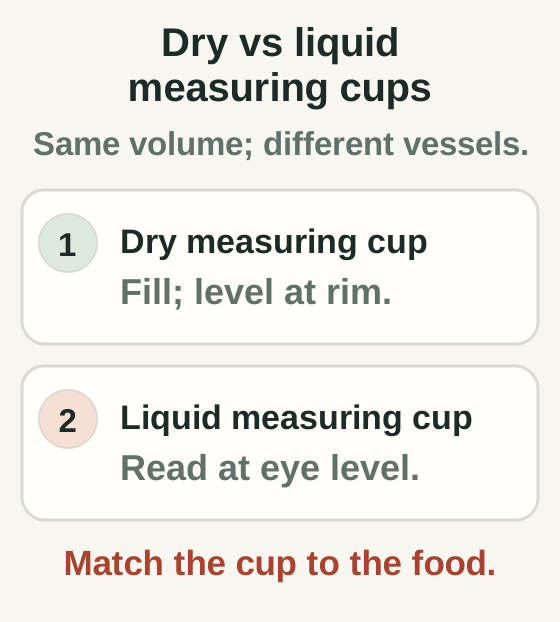
Which vessel matches the ingredient?
A US dry measuring cup and a US liquid measuring cup represent the same nominal cup volume. Their shapes solve different problems: a dry cup has a rim you can fill and level; a transparent liquid jug has a marked line and space above it, so you can read and carry liquid without filling to the brim. The type of cup does not change the US volume unit.
Use a rim-level dry cup for flour, sugar, oats and other ingredients that do not settle into a readable liquid line. Pourable, self-leveling ingredients such as water, milk and stock belong in a liquid jug. Thick yogurt, sour cream and nut butter also tend not to self-level. For ½ cup of peanut butter, spoon it into a ½-cup dry measure, ease it into the corners to close large air pockets without overpacking, level the rim and scrape it into the mixing bowl. Use the same approach for other thick ingredients when the recipe calls for a cup measure. If the recipe gives a weight, measuring that amount on a scale also avoids residue left in the cup. Do not press in extra ingredient beyond a level measure unless the recipe specifically says to pack it.
For pourable liquids, place the jug on a level counter and read the settled surface at eye height; for clear liquids with a concave meniscus, use the bottom of its curve. For flour, follow the recipe author's measuring method rather than compacting it to match a side mark. A flour mound cannot be leveled accurately inside a tall liquid jug, while liquid in a brim-full dry cup can spill or sit above the rim because of surface tension. Two properly filled US cups of oats and two of milk indicate the same volume, not the same weight.
Dry and liquid measuring cups
| Point | Dry cup | Liquid cup |
|---|---|---|
| Nominal amount | US cup volume | US cup volume |
| How it is read | Fill and level at the rim | Read marked line at eye level |
| Good for | Flour, sugar, cocoa | Water, milk, stock |
| Special case | Pack brown sugar if instructed | Read the liquid surface on a level counter |
What to do when you have only one cup type
Only a liquid jug for flour? If the recipe provides a gram weight and you have a scale, weigh the flour instead. A liquid jug's marked line is hard to use for a powder that mounds and traps air. If you also have calibrated US measuring tablespoons, 16 level tablespoons equal one US cup by volume, but the repeated scoops introduce enough variation that this is a rough cooking fallback, not a reliable precision-baking method.
Only a dry cup for water or milk? Place it on a steady surface, fill carefully to the level rim—not to a bulging dome—and pour into the mixing bowl slowly. A dry cup has no headroom, so some liquid may spill on transfer. For recipes where the quantity matters closely, a graduated jug lets you measure to a marked line without that problem.
No dry cup, scale or calibrated spoon for a dry ingredient? A dinner spoon and a guessed flour level in a liquid jug are not substitutes for a specified, repeatable baking measurement. A recipe's gram amount is helpful only if you can use a scale; otherwise borrow or obtain a correctly sized dry cup or scale before a precision-sensitive bake. For general measuring technique, see the focused liquid-measuring guide; it covers hard-to-read surfaces and sticky ingredients in more detail.
Check cup and ounce labels before converting
An ingredient labeled 8 US fl oz is one US cup by volume; 8 oz on a weight label is a mass and cannot be converted to cups without identifying the ingredient. See fluid ounces versus weight ounces before substituting. A US customary cup is about 236.6 mL (rounded to 237 mL in NIST's kitchen volume table), whereas a cup on US nutrition labeling is defined as 240 mL for that labeling purpose. Follow the recipe's stated cup convention or its milliliter amount instead of assuming all printed cup values use the same standard.
Method guidance for dry, pourable and thick ingredients: King Arthur Baking measuring-cup guidance.