
Fluid Ounces vs Ounces in Cooking
In US cooking, fl oz measures volume and oz normally means mass. Eight US fl oz is one cup (about 236.6 mL); eight oz by weight is about 226.8 g. They are not interchangeable without ingredient density. Check the recipe's unit system before converting.
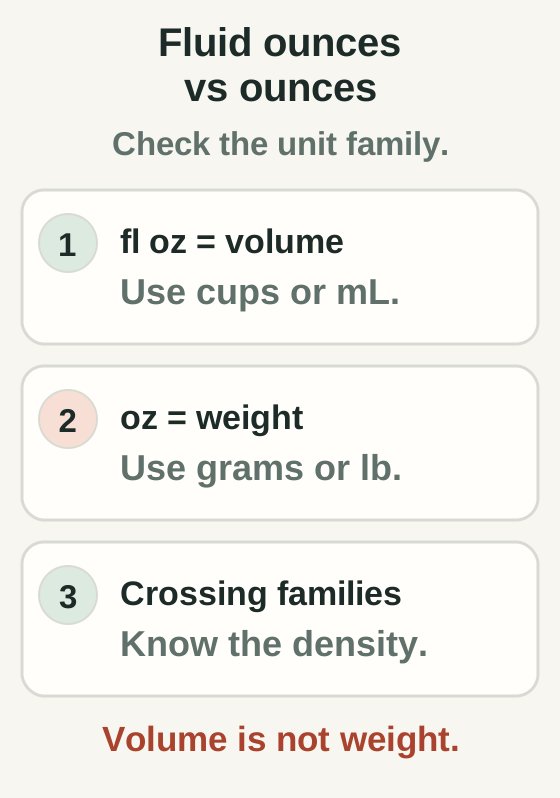
Fluid ounces and ounces
| Unit | Measures | Common use | Direct conversion family |
|---|---|---|---|
| US fl oz | Volume | Milk, stock, beverages | mL, cups, pints |
| oz | Weight | Flour, chocolate, butter | grams, pounds |
| fl oz to oz | Volume to weight | Ingredient-dependent | Density required |
Read the unit on the recipe or package first
If a US recipe asks for 8 fl oz of stock, measure one US cup in a graduated liquid jug. If it asks for 8 oz of butter, chocolate or cheese, weigh about 226.8 g on a scale. A matching number does not mean matching quantities: fl oz is volume, while an ordinary oz is mass. Choose the tool from the written unit, not from whether the ingredient looks solid or liquid.
Look for the net-quantity statement on a US package. '12 fl oz (355 mL)' is a volume; 'Net wt 12 oz (340 g)' is mass, including when the contents are thick or pourable. US food net-quantity labeling rules generally use volume for liquids and weight for solid, semisolid and viscous foods, with established trade-practice exceptions. Do not infer the unit from a phrase such as '12-oz drink' when the printed quantity declaration is available.
Within the same kind of unit, no ingredient density is needed: 1 US fl oz is about 29.5735 mL, and one ordinary oz is about 28.3495 g. Thus 6 US fl oz of broth is ¾ US cup (about 177.4 mL), while 6 oz of grated cheese is about 170.1 g by weight. The fluid-ounces-to-cups converter is for volume, not cheese weight.
Converting fl oz to weight requires an ingredient reference
First check whether you actually need a cross-unit conversion. If the recipe states fl oz, use a marked liquid measure; if it states oz by weight, use a scale. If you must translate one to the other, you need a reliable density for that ingredient and its relevant temperature or physical state, expressed in grams per milliliter (g/mL), or a recipe-author weight for the measured portion. There is no universal ounces-per-fluid-ounce factor.
With a known density, use this sequence for US units: fluid ounces × 29.5735 = milliliters; milliliters × density (g/mL) = grams; grams ÷ 28.3495 = mass ounces. Reverse it by converting mass ounces to grams (× 28.3495), dividing by density to obtain milliliters, then dividing by 29.5735 to obtain US fluid ounces. Do not use these steps when the ingredient or density is unknown.
Water demonstrates the difference without assuming all liquids behave alike. At about 21°C (70°F), the USGS water-density table gives about 0.99802 g/mL. Eight oz of water by weight is 226.8 g: dividing by that density gives about 227.2 mL, or 7.68 US fl oz. In contrast, 8 US fl oz of water occupies about 236.6 mL and weighs about 236.1 g at that temperature. Equivalently, 1 US fl oz of this water weighs about 1.04 oz by mass, not exactly 1 oz. These are calculations from published factors, not kitchen tests; never reuse water's density for oil, syrup, flour or another ingredient.
If the ingredient-specific density or weight reference is missing, stop the cross-unit calculation rather than invent a precise value. Use the recipe's stated mass with a scale, its stated volume with an appropriate measure, or ask the recipe publisher for a weight/volume equivalent. A nutrition label's grams per serving do not automatically tell you the density of a full cup without a matching serving volume and preparation state.
Check US, Imperial and unclear abbreviations
A UK Imperial fluid ounce is about 28.41 mL, rather than the US 29.57 mL. The cup and fl-oz calculations here use US customary volume. For a recipe from another country, favor its stated mL amount or verify the system before applying US conversion factors.
If a handwritten or older recipe says only 'oz' without a clear meaning, compare any accompanying g/lb (weight) or mL/fl oz (volume), check the author's measurement key and avoid silently guessing. The recipe measurement abbreviations guide covers other regional and handwritten symbols.
US household-volume relationships: NIST household weights and measures.