
Granulated Sugar Cups to Grams
This page converts level white granulated sugar at King Arthur Baking's 198 g per US cup. Another established recipe chart lists 200 g for the same sugar, so the recipe's own weight should come first.
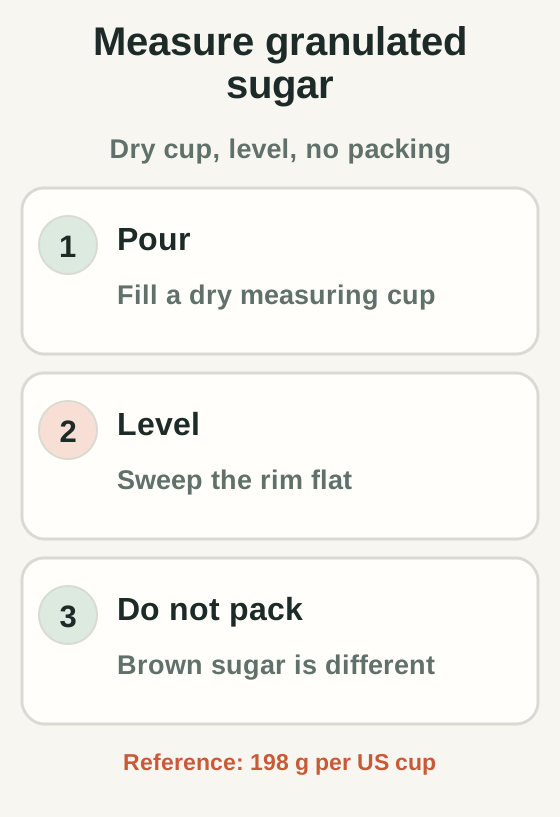
Reference measurement
198 grams per US cup
Pour into a dry US cup and level.
King Arthur Baking lists 1 cup granulated white sugar as 198 g. Source note
This 198 g per cup reference is for granulated white sugar, not superfine/caster sugar; King Arthur Baking lists its Baker's Special superfine (castor) sugar at 190 g per cup.
Common Granulated Sugar measurements
| US cups | Grams |
|---|---|
| 0.25 US cups | 49.5 grams |
| 0.333 US cups | 66 grams |
| 0.5 US cups | 99 grams |
| 0.667 US cups | 132 grams |
| 0.75 US cups | 148.5 grams |
| 1 US cup | 198 grams |
| 1.5 US cups | 297 grams |
| 2 US cups | 396 grams |
Practical examples
- 1/2 US cup = 99 grams.
- 1 US tablespoon = 12.38 grams.
- 3 US teaspoons = 12.38 grams.
Measuring note
Pour into a dry US cup and level.
This 198 g per cup reference is for granulated white sugar, not superfine/caster sugar; King Arthur Baking lists its Baker's Special superfine (castor) sugar at 190 g per cup.
When 198 and 200 both refer to white granulated sugar
King Arthur Baking lists 198 g for one US cup of granulated white sugar, while Sally's Baking lists 200 g for the same named category. These are two publisher reference choices, differing by 2 g per cup. This page has not independently verified a USDA cup figure, so it does not present either number as a USDA-certified conversion.
For 1½ cups, the respective chart calculations give 297 g and 300 g. If your recipe actually specifies 300 g, follow the recipe instead of changing it to 297 g to agree with this calculator. If it states cups only, use its author's standard when known, and don't average two charts into an unsupported third value.
190 grams is a different sugar, not rounding of 198
The same King Arthur weight chart separately specifies Baker's Special superfine (castor) sugar at 190 g per cup. Thus 1½ cups of that named product correspond to 285 g, not the 297 g shown here for white granulated sugar. That 12 g difference compares products within one chart, unlike the 3 g difference above between two publishers' white-sugar charts.
King Arthur's original sugar-type guide explains why sugar selection affects how it functions in a recipe. If the instructions name caster/superfine, packed brown or powdered sugar, use an appropriate ingredient-specific reference or the author's listed grams; don't silently reuse the white-granulated weight.
For dry white granulated sugar, use a dry US cup, fill and level at the rim, and do not pack. Packing brown sugar and sifting confectioners' sugar are separate procedures with their own ingredient weights. A decimal result from a cup converter is conditional on both the actual sugar and the volume method; it is not a universal density measured for every granule size.