
Grams vs Cups: What 100 g Means for Flour and Sugar
100 g is not one fixed number of cups. Under King Arthur Baking’s chart, 100 g of all-purpose flour is ⅚ US cup (about 0.83), white granulated sugar about ½ cup (0.51), and solid butter about 0.44 cup. If your recipe gives grams, weigh them; if you only have cups, match the ingredient and the recipe author’s measuring method first.
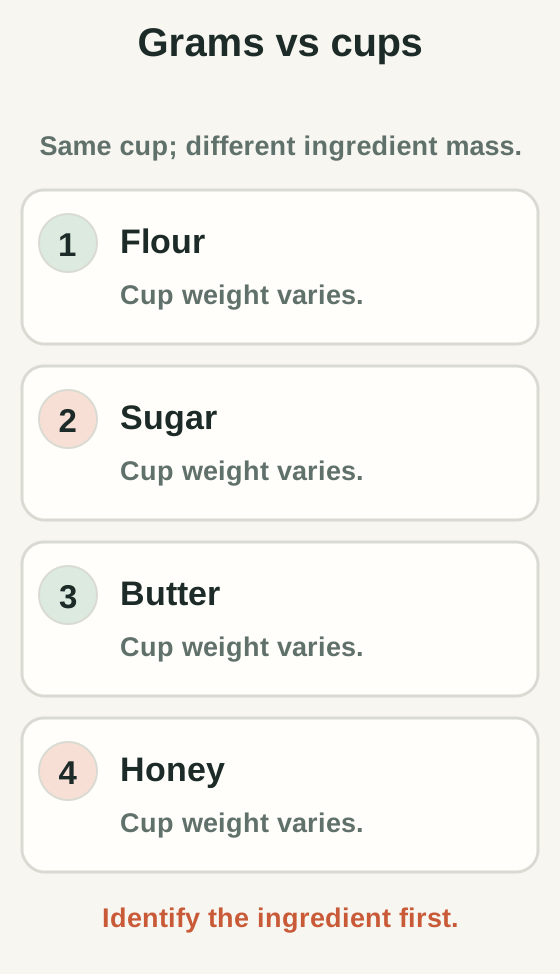
Your recipe says 100 g of flour. Which cup amount can you use?
If you have a kitchen scale, stop here: tare a bowl and weigh 100 g of the flour named by the recipe. Cups are a useful fallback, not an improvement on an already supplied mass. Without a scale, look for the recipe author's cup-weight standard before converting. Under King Arthur Baking's ingredient-weight chart, one lightly filled US cup of all-purpose flour weighs 120 g, so 100 ÷ 120 = 0.8333 cup, or ⅚ cup under that specific reference.
To approximate ⅚ US cup with a common set of dry cups, use one level ½ cup + one level ¼ cup + one level US tablespoon + one level US teaspoon. Those add up to ½ + ¼ + 1/16 + 1/48 = ⅚ cup. Spoon the flour in and level each measure; don't pack it. This only works as written if you actually have calibrated US measuring spoons. Without them, don't treat a random eating spoon or a guessed partial cup as a precise substitute for the 100 g target.
The ingredient matters just as much as the cup: the same chart makes 100 g white granulated sugar about 0.51 cup (one level ½ cup holds approximately 99 g under that reference), while 100 g solid butter is about 0.44 cup. For butter sold in marked US sticks, seven tablespoons give approximately 99 g under King Arthur's 113 g-per-half-cup convention. None of these measures turns 100 g into a universal volume.
Why one cup has different weights
| Ingredient and state | 1 US cup (g) | 100 g to US cups | 200 g to US cups |
|---|---|---|---|
| All-purpose flour | 120 g | 0.83 cup | 1.67 cups |
| Granulated sugar | 198 g | 0.51 cup | 1.01 cups |
| Brown sugar (packed) | 213 g | 0.47 cup | 0.94 cup |
| Butter | 226 g | 0.44 cup | 0.88 cup |
| Honey | 336 g | 0.30 cup | 0.60 cup |
Why 100 g of all-purpose flour can mean ⅘ or ⅚ cup
For 100 g of all-purpose flour, The Calculator Site's conversion table gives 0.8 US cup (⅘ cup), while King Arthur Baking's 120 g-per-US-cup reference gives 100 ÷ 120 = 0.8333 US cup (⅚ cup). If you measure ⅘ of a cup using King Arthur's 120 g reference, you get 96 g, not 100 g. That difference comes from the weight-per-cup assumption, not from a new volume unit. The Calculator Site separately approximates 100 g of bread flour at ¾ cup; do not mistake that for its all-purpose flour row. Follow the recipe publisher's ingredient and measuring method rather than choosing a fraction by appearance.
Even established bakers use different flour methods. Sally's Baking uses 125 g per cup, putting 100 g at 0.80 cup. America's Test Kitchen uses a dip-and-sweep reference of 5 weight ounces (about 142 g) per cup, making 100 g about 0.70 cup. Their recipes are written around their methods. For a recipe calling for 1½ cups, the three respective standards would yield about 180 g, 187.5 g, or 213 g—a consequential 33 g gap between the first and last. Find the original recipe's method instead of averaging incompatible chart entries.
If the publisher supplies a gram amount alongside the cups, follow that gram amount with a scale when possible. If the publisher gives cups only, follow its specified filling method and the cup sizes it actually uses. Our flour-measuring guide demonstrates the physical differences; this page explains which conversion assumption belongs with the recipe.
Before using the table, check the spoon, cup and ingredient state
Every result in the table is for US cups and the named ingredient state. A US customary cup is about 236.6 mL (NIST rounds it to 237 mL for household use). A metric cup may be 250 mL. The spoon combination above assumes US measuring spoons; Donna Hay's Australian conversion reference uses a 20 mL Australian tablespoon, rather than the approximately 15 mL North American tablespoon. Do not interchange those utensils without revisiting the volume.
The row for brown sugar assumes packed brown sugar, not sugar loosely poured in. The butter row's 226 g per US cup is derived from King Arthur's published 113 g for a half cup; honey's 336 g per cup is derived from 21 g per US tablespoon × 16. Those are stated-reference calculations, not independent measurements of every product. Granulated sugar, packed brown sugar, solid butter and liquid honey require different handling; the diagram and comparison chart are not instructions to fill all five cups the same way.
The 100 g and 200 g results in the table are rounded comparison values, not markings you will necessarily find on a measuring cup. For another mass, the grams-to-cups ingredient calculator applies this site's named reference after you choose the actual ingredient. If you have a working scale or a recipe-specified mass, keep the grams rather than converting twice.
Ingredient-specific volume-to-mass references: King Arthur Baking ingredient weight chart.