
Converting Recipes Between US and Metric Measurements
Convert volume, mass and oven temperature as separate tasks. Identify the ingredient before cup-to-gram estimates, and round metric results to what a kitchen measure can show.
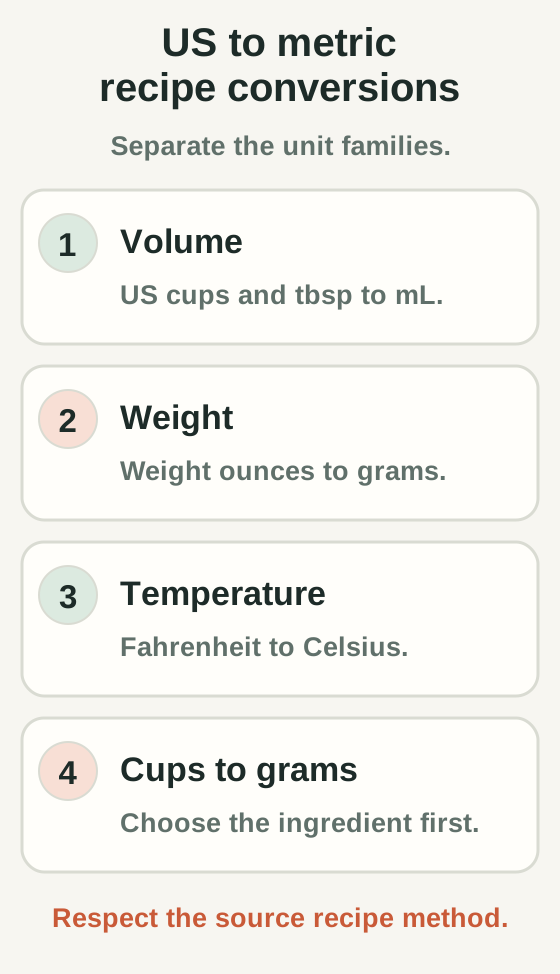
Decide which recipe quantities can be converted directly
US cups, tablespoons, teaspoons and fluid ounces describe volume. Once you identify the recipe's unit standard, convert those amounts to milliliters. Weight ounces and pounds convert to grams by mass; Fahrenheit converts separately to Celsius. Do not mistake a weight ounce of chocolate for a fluid ounce.
Cups-to-grams are different: a cup of all-purpose flour and a cup of granulated sugar have different masses. For the worked example below, King Arthur's ingredient reference uses about 120 g per US cup of its all-purpose flour, while its white granulated sugar reference is 198 g per US cup. Check the source recipe's measuring method before adopting either value.
A recipe author's flour method matters as much as its cup size. Quaker Oats' original measurement chart distinguishes 115 g per cup for sifted all-purpose flour, 125 g for spooned flour and 145 g for dipped flour. If the original recipe follows that dipped 145 g reference, substituting the worksheet's King Arthur 120 g for its one-cup line would omit 25 g, about 17% of the intended flour mass. These are published reference methods, not universal flour densities; follow the original recipe's own grams or stated filling technique.
A hypothetical chocolate snack cake: complete US-to-metric working list (not tested)
| Original illustrative line | Metric working line | Why this amount |
|---|---|---|
| 1 US cup all-purpose flour | 120 g | King Arthur's named flour reference; method-dependent |
| 1/2 US cup white granulated sugar | 99 g | Half of King Arthur's 198 g-per-cup sugar reference |
| 1/2 US cup milk | ≈ 118 mL | Fixed volume: 0.5 × 236.5882365 mL |
| 2 US tbsp oil | ≈ 30 mL | Fixed volume: 2 × 14.7867648 mL |
| 1 large egg | 1 large egg | Count unchanged; no assumed egg mass |
| 2 oz chopped chocolate (weight) | ≈ 57 g | Mass: 2 × 28.349523 g, not fluid ounces |
| 1 US tsp baking powder | ≈ 5 mL (one calibrated metric tsp) | Fixed volume: 1 US tsp ≈ 4.93 mL; no inferred gram mass |
| 350°F conventional oven | ≈ 177°C conventional oven | Temperature conversion; convection choice remains separate |
Convert one complete hypothetical chocolate snack-cake list
This is one coherent conversion exercise: an imaginary chocolate snack-cake ingredient list plus its oven setting. It is not a kitchen-tested formula or instructions to bake. The worksheet converts every item on that one list, including a counted egg, so that no ingredient or unit family quietly disappears.
To see why the numbers differ, calculate the half-cup sugar as 0.5 × 198 g = 99 g using the named sugar reference, but calculate the half-cup milk as 0.5 × 236.5882365 mL = 118.29 mL using US customary volume. Two US tablespoons of oil become 29.57 mL, while two weight ounces of chocolate become 56.70 g. Keep one egg as one egg. One US teaspoon of baking powder is about 4.93 mL of volume, so a calibrated 5 mL teaspoon is a practical reading; this is not a claim about its mass.
The oven line is a different calculation: 350°F corresponds to 176.7°C. Set the closest suitable temperature supported by the appliance and the actual recipe. Do not automatically lower it again for convection unless the recipe or oven instructions call for that change.
Now check the actual measures you own before using the converted list. Annabel Langbein's NZ/Australian kitchen conversions notes that Australian tablespoons hold 20 mL, whereas her NZ, UK and US tablespoon convention is approximately 15 mL. Pouring two full Australian tablespoons of oil for this example would give 40 mL, not the worksheet's approximately 30 mL from two US tablespoons. Use a graduated 30 mL measure rather than substituting two Australian tablespoon scoops. Likewise, half of a 250 mL metric cup holds 125 mL; the recipe's half US cup of milk is about 118 mL, so use the milliliter markings or a suitably small jug rather than an unexamined metric half-cup measure.
Use the converted list without changing the recipe
Write the metric quantities beside the original lines and preserve any gram or milliliter amounts that the recipe author supplied. Round liquids to what your jug can reliably show; 118.29 mL is a calculation, not a request to measure hundredths of a milliliter. The flour and sugar masses in the worksheet are reference-based estimates, not universal values for every brand, packing method or recipe.
A metric cup may mean 250 mL and an Australian tablespoon 20 mL, whereas the US customary cup in this worksheet is 236.5882365 mL. A 240 mL cup on a US nutrition label is also a different rounded labeling convention. Identify the original recipe's country and unit definitions before converting.
The cooking-measurement converter handles individual unit conversions; the cups-to-grams converter needs the actual ingredient. Neither tool converts or validates an entire recipe automatically. For a real bake, follow its original method, ingredient specifications and oven guidance rather than treating this hypothetical list as a ready-to-cook recipe.
Official US customary volume unit relationships: NIST household metric equivalents.