
How to Scale a Recipe
Paste your ingredient list to scale all recognized quantities from original to desired yield. Keep the recipe’s original units, then check eggs, pans, seasoning and doneness separately.
Scale your entire ingredient list
Enter your original and desired yields, then paste an ingredient per line. Recognizable leading quantities are multiplied and their units stay unchanged; review uncertain lines before cooking.
Only the first amount per line is scaled. Unrecognized amounts, ranges, times and instructions remain explicitly marked REVIEW. Secondary numbers (such as can sizes) and units are not converted. Beat and weigh partial eggs; separately assess leavening, pans, seasoning and doneness. Your ingredient list stays in your browser.
Calculate the batch multiplier
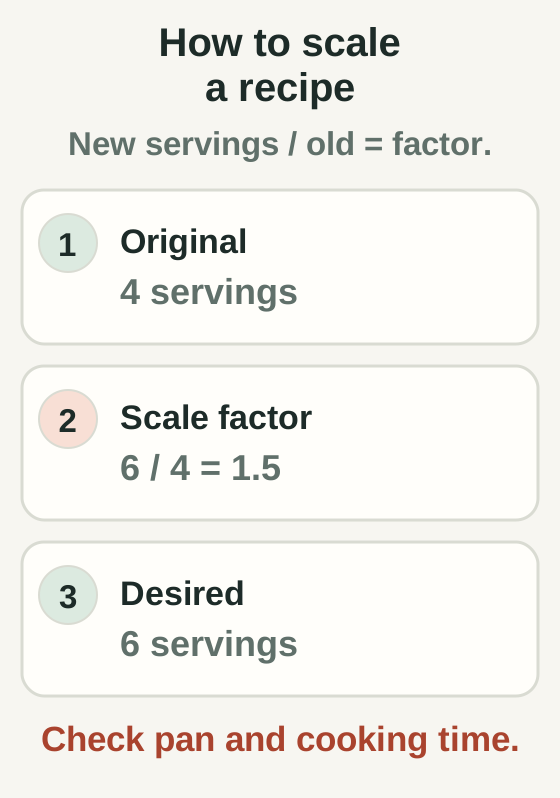
Divide the desired yield by the original yield, using the same basis for both: servings to servings, or batches to batches. For four servings becoming six, 6 ÷ 4 = 1.5; multiply measured ingredient quantities by 1.5. One cup becomes 1½ cups and two tablespoons become three tablespoons. For half a batch, use 0.5. The four-row chart below shows a hypothetical four-to-six-serving calculation, not a kitchen-tested recipe. Even perfectly scaled ingredient quantities do not determine the right pan, oven temperature or cooking time.
Use the ingredient-list scaler above to multiply recognized leading amounts while keeping each line's original unit. Check its result against the source list before cooking; it does not turn grams into cups, rewrite instructions or decide whether a fraction of an egg can be measured directly.
Illustrative scaling math: four to six servings (factor 1.5)
| Original measure | New measure | Calculation |
|---|---|---|
| 200 g flour | 300 g flour | 200 × 1.5 |
| 250 mL milk | 375 mL milk | 250 × 1.5 |
| 1 large egg | 1½ large eggs (≈ 75 g beaten) | 1.5 × ≈ 50 g; weigh the actual egg |
| 2 US tsp baking powder | 3 US tsp baking powder | 2 × 1.5 |
Resolve REVIEW warnings before cooking
A line marked REVIEW was not reliably rescaled. For example, '1–2 cups flour' is a range, so the factor 1.5 would make its endpoints 1½–3 cups, not a single required amount. The recipe's intended texture still decides where in that range to stop. 'Salt to taste' has no fixed starting quantity to multiply; season carefully by taste where appropriate. Keep '350°F' oven settings and '30 minutes' cooking instructions out of the ingredient list instead of multiplying them.
Warnings can also appear when the first amount was scaled correctly but other numbers were deliberately left alone. '2 (14 oz) cans tomatoes' becomes '3 (14 oz) cans tomatoes' at a factor of 1.5: the can count changes, not the 14 oz printed on each can. Check package sizes before buying, particularly if only different can sizes are available. Read every warning and manually resolve every unchanged REVIEW line before relying on the copied list; a count such as '3 of 4 lines scaled' means one line still needs attention.
Handle fractional eggs and small additions
The tool may output '1.5 large egg' from one original egg at a factor of 1.5. Crack and lightly beat two similarly sized eggs, weigh the combined contents and use three-quarters of that beaten mixture. King Arthur Baking lists roughly 50 g for one large egg without the shell, so about 75 g is a useful estimate for 1½ large eggs, not an exact universal weight. For half an egg, beat one and use half its measured weight. If the original recipe specifies egg grams, scale that stated weight instead.
Calculate proportional leavening and yeast first, then follow the recipe's mixing, rise and doneness cues. Two teaspoons of baking powder at a 1.5 factor becomes three teaspoons; do not quietly add extra because the batch is larger. Use a calibrated measuring spoon or scale for small amounts. Salt and concentrated seasonings may need gradual adjustment rather than blind multiplication of the final taste.
Check pan capacity and doneness separately
For a cake with similar batter depth, pan base area is a starting comparison, not a guaranteed substitution. A 9 × 9-inch pan has 81 square inches of base area; half its batter suggests about 40.5 square inches. A 7-inch round pan is roughly 38.5 square inches and an 8½ × 4½-inch loaf pan roughly 38.25, compared with about 50.3 for an 8-inch round. Actual inside dimensions, wall height, pan material, recipe shape and available capacity still matter. This area shortcut does not apply mechanically to roasts or bread loaves.
Before enlarging a batch, check bowl, mixer and pan capacities against the manufacturer's limits; split into batches if necessary. Cooking time does not scale with the ingredient multiplier. Watch the original recipe's doneness cues, checking earlier for smaller or shallower portions and adjusting for a deeper pan or crowded oven. For meat and poultry, use a food thermometer to confirm the applicable safe minimum internal temperature rather than multiplying the clock. Record the real pan and time only after you have cooked the adjusted recipe. The separate recipe-scaling calculator computes a factor; neither calculator can select a safe pan or verify doneness.
Practical pan, egg and timing considerations: King Arthur Baking: how to reduce a recipe.