
Fan Convection vs Conventional Oven Temperatures
Changing °F to °C is a unit conversion. Switching to convection is a different choice about airflow, browning and a particular oven's settings.
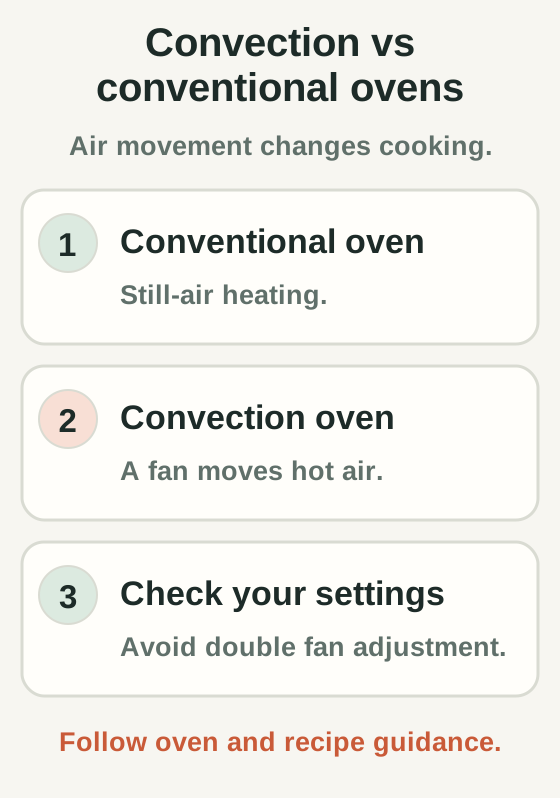
Check what the oven's fan mode actually does
A conventional oven heats food by radiation from the oven surfaces and natural air circulation. In a convection oven, a fan also moves hot air over the food, which can transfer heat and remove surface moisture more quickly. That is why cookies, vegetables and uncovered proteins may brown sooner while a deep loaf or covered dish reacts differently.
Some ovens use fan-only circulation and others add a rear heating element. Models may automatically compensate for convection settings. Check the appliance manual before applying any rule to the displayed control: selecting a convection mode may already adjust the effective temperature. For example, LG's instructions for certain convection ranges describe entering 350°F and seeing 325°F after the oven applies its automatic 25°F adjustment. This is a model-specific example, not a setting all convection ovens share.
Here is the control choice for one actual recipe line: if a conventional recipe says 375°F, fan-off Bake stays at 375°F (about 191°C). If you deliberately choose a convection setting that does not auto-convert, 350°F (about 177°C) may be a useful 25°F-lower starting point for an appropriate food. On a model with automatic convection conversion, instead follow the manual's entry procedure for the original 375°F: some controls will show an adjusted 350°F after conversion. If you first enter a manually reduced 350°F and the oven also subtracts 25°F, it can end up displaying 325°F—50°F below the original conventional setting. LG's convection control instructions demonstrate this automatic behavior for a 350°F entry, and King Arthur Baking's convection guide describes an oven that converts an entered 375°F to 350°F. Do not assume the auto-conversion feature is on or off without checking your own mode and manual.
Choose the next check before adjusting the oven
| Situation | What to verify | Practical next step |
|---|---|---|
| Oven automatically compensates for convection | Appliance manual and display | Avoid a second automatic 25°F reduction |
| Layer cakes, cupcakes, wet muffins or quick breads | Recipe and oven-manual fan guidance | Conventional (fan-off) mode is often the better starting choice |
| Conventional recipe, fan mode needed | Food type, manufacturer setting | Consider a 25°F lower starting setting if appropriate |
| Thin cookies or vegetables browning quickly | Surface condition and rack placement | Check earlier; use recipe's doneness cues |
| Poultry, meat or deeply cooked dishes | Safe internal temperature guidance | Use an appropriate food thermometer |
Use a 25°F reduction only as a qualified starting point
King Arthur Baking's convection discussion describes a common starting suggestion: lower a conventional baking temperature by about 25°F and check baking earlier. For a recipe originally calling for 375°F, that suggests 350°F as one possible fan-mode starting setting, only if the appliance does not already adjust it and the food/recipe warrants the change.
That is not the same as converting units. 375°F is about 190.6°C, whereas 350°F is about 176.7°C; both are Celsius equivalents of different physical settings. A converter can give either numerical equivalent, but it cannot choose a fan reduction or guarantee baked texture. For many layer cakes, cupcakes, wet muffin batters and quick breads, King Arthur Baking recommends baking with the fan off; those are concrete cases in which conventional mode can preserve the intended texture. Check your recipe and oven manual, since this is not a universal ban on convection for every cake. A newer King Arthur baker's account reports successful convection baking for many foods with a different oven, while warning that strong fans can disturb thinner batters. Oven design, fan intensity and the food's surface matter more than a blanket fan-on or fan-off rule.
Fan airflow is often helpful for roasted vegetables or multiple trays with space for air circulation. It can over-brown thin edges or dry exposed surfaces when timing and rack placement are copied from a still-air recipe. A covered braise behaves differently because its lid restricts evaporation and direct airflow.
Check cookies, cake surfaces or roasted vegetables earlier than the original end time, then rely on the recipe's doneness cues. Never multiply bake time by a fixed fan factor as if ovens, pan depths and food size were identical. For meat and poultry, use a suitable food thermometer and the applicable safe minimum internal-temperature guidance, not color alone.
For a poultry dish, a browned exterior or an early timer check is not evidence of safe doneness. FoodSafety.gov's original safe-temperature chart lists 165°F (74°C) as the safe minimum internal temperature for chicken and other poultry, regardless of convection or conventional mode. Measure the food at an appropriate thick point with a food thermometer, and follow the guidance for the actual ingredient; this is not an oven set-temperature target. Do not apply the 25°F air-temperature example to a food-safety endpoint.
Separate oven calibration from the recipe's doneness cues
If a batch regularly cooks faster or slower on either mode, use a standalone oven thermometer to check the real cavity temperature and compare with the appliance manual. An inaccurate thermostat can imitate a fan-related difference. One unexpectedly dark tray does not prove that the oven is miscalibrated: rack position, pan finish and food spacing also change results.
Treat the on-site oven-temperature converter as a tool for converting °F ↔ °C or Gas Mark approximations, not as a diagnostic system or an exact oven-mode selector. The most defensible next action is to read the specific oven's instructions and test doneness within the recipe's safe parameters.
Publisher-tested baking guidance and mode-dependent adjustments: King Arthur Baking: convection oven versus traditional oven.